5 Questions to Ask a Foot Care Nurse Before You Book

Last Updated: October 27, 2026
Quick Summary
Ask a foot care nurse about their nursing registration and foot care certificate, how they sterilize instruments between clients, what happens during a home visit, whether they can manage your specific risks such as diabetes or poor circulation, and what the fees, coverage and cancellation policy are. A good foot care nurse answers each with specifics, not vague reassurances.
A qualified foot care nurse holds current nursing registration and a recognized foot care certificate.
Nursing foot care excludes surgery, prescription medication and complex structural correction, which belong to a podiatrist or chiropodist.
A home foot care visit usually takes under an hour and follows a consistent step-by-step order.
Higher-risk feet from diabetes, neuropathy or poor circulation need a slower pace and a referral pathway.
Ask for current pricing and the cancellation policy in writing before you book.
Table of Contents
Question 1: What Foot Care Nurse Qualifications and Scope of Practice Do You Hold?
Question 2: How Do You Handle Safety, Infection Control, and Instrument Sterilization?
Question 3: What Happens During a Visit, and How Do You Prepare for a Foot Care Appointment?
Question 4: Can You Manage My Specific Risks, From Diabetes to Poor Circulation?
Question 5: What Are the Fees, Coverage Options, and Visit Logistics?
Why the Right Questions Change Your Foot Care
A foot care nurse is a licensed health professional who assesses, treats and prevents problems with the feet, nails and lower legs, often in a client's own home. Asking the right questions before you book tells you whether that person is qualified, safe and suited to your specific risks. Below are the top five questions to ask a foot care nurse, with the answers that should make you comfortable, and the ones that should make you pause.
Question 1: What Foot Care Nurse Qualifications and Scope of Practice Do You Hold?
A qualified foot care nurse should hold a current nursing registration and a recognized foot care certificate. Ask for both, and ask how they keep them current.
We are led by Gellis Jerome-Milandou, a licensed Registered Practical Nurse and Foot Care Specialist.
Credentials to Look For
Active registration with the provincial nursing regulator
A foot care certificate from a recognized program
Current first aid and CPR training
Proof of professional liability insurance
Watch out: a provider who cannot name their regulator or produce a certificate is a red flag. Polished marketing is not a credential.
Where Nursing Ends and Podiatry Begins
Nursing foot care covers assessment, nail trimming, callus and corn care, and basic wound prevention. It does not cover surgery, prescription medication or complex structural correction. Those belong to a podiatrist or chiropodist. A good nurse knows the line and refers you over it without being asked. If you're weighing the roles, our guide to foot care nurse vs podiatrist explains what each one can and cannot do.
Question 2: How Do You Handle Safety, Infection Control, and Instrument Sterilization?
Infection prevention is the clearest signal of a serious provider. Ask how instruments are cleaned between clients, and listen for specifics, not reassurances.
Many clients also worry about letting a stranger into their home. It is fair to ask about screening and identification. You can read how we answer these concerns on our frequently asked questions page.
Watch out: "we clean everything" is not an answer. Ask which products and which steps.
Question 3: What Happens During a Visit, and How Do You Prepare for a Foot Care Appointment?
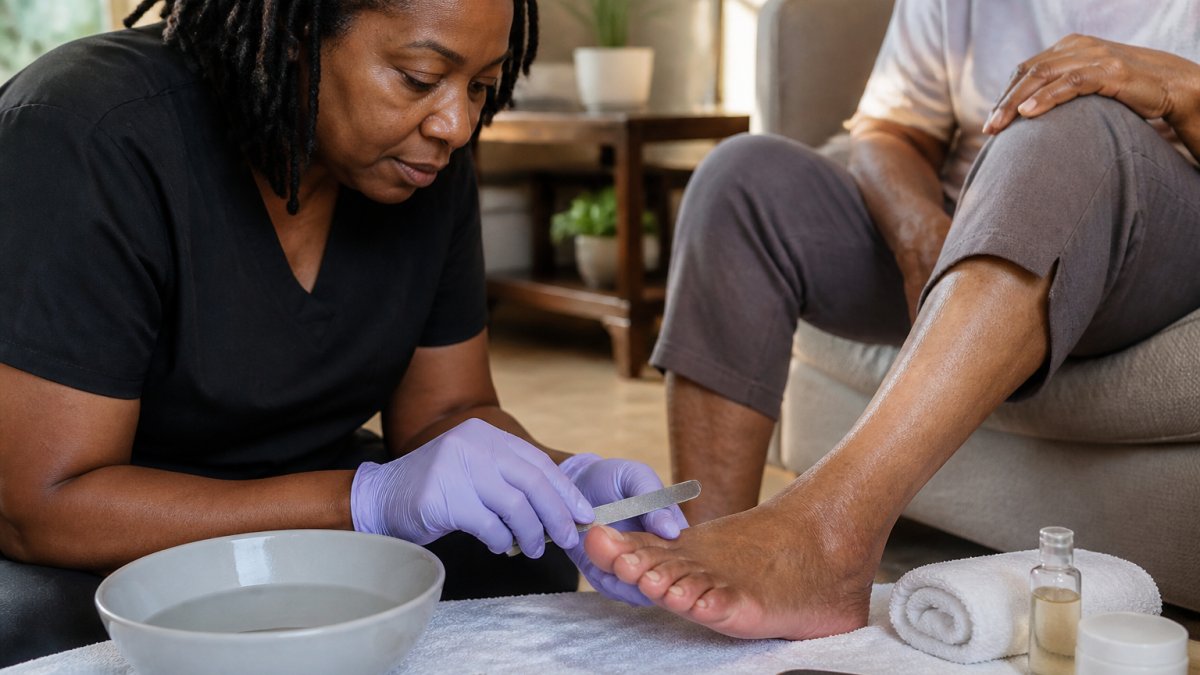
A home foot care visit usually takes under an hour and follows a consistent order: health history, visual inspection, circulation and sensation checks, then nail and skin care. Knowing the sequence, and what each step is actually testing, removes most of the anxiety and helps you judge whether the nurse is doing a real assessment or just a cosmetic trim.

What to Expect During a Home Foot Care Visit
A short conversation about warning signs. A good nurse tells you what to watch between visits and when to call back rather than wait. (Source: Public Health Agency of Canada's guidelines on infection prevention and control)
What the Findings Actually Mean
A visit is not just a service, it is a baseline. If the nurse documents pulses, sensation, skin integrity, and nail condition at the first visit, later visits can be compared against it. That is how small changes get caught before they become wounds. Ask whether findings are recorded and shared with your family doctor or nurse practitioner; continuity is part of good foot care.
Simple Steps to Get Ready
Clear a chair near good light. Wash your feet beforehand, and wear loose footwear. Have a towel and a pair of clean socks nearby. If you have a wound or a new area of redness, do not cover it with cream before the visit. Our walkthrough on how to prepare for your in-home appointment covers the rest in detail.
Pro Tip Ask the nurse to walk you through what they are checking as they go.
Question 4: Can You Manage My Specific Risks, From Diabetes to Poor Circulation?
If you live with diabetes, neuropathy, poor circulation, or a history of wounds, ask directly whether the nurse handles higher-risk feet, and ask what changes in your care because of it. You can also review our diabetic foot care in Brampton service to see whether it fits your risk profile.
How Care Changes for Higher-Risk Feet
Mobility limitations. If you cannot easily reach your feet or see the soles, the nurse checks areas you cannot, heels, between toes, and the bottom of the foot, and can suggest tools or positioning that help between visits.
Red Flags That Need More Than Routine Care
If you are weighing the roles, our guide to foot care nurse vs podiatrist explains what each one can and cannot do.
Question 5: What Are the Fees, Coverage Options, and Visit Logistics?
Ask for current pricing before booking, and ask what the visit includes and what happens if you need to reschedule.
Confirm the cancellation policy in writing.
Question | Good Answer Sounds Like | Red Flag |
Credentials | Names regulator and certificate | Avoids specifics |
Safety | Describes sterilization steps | "We clean everything" |
Visit flow | Clear step-by-step order | Can't describe a visit |
High-risk care | Slower pace, referral pathway | "We handle everything" |
Fees | Written quote, clear policy | Vague or evasive |
A Foot Care Checklist for Caregivers Before the First Visit
Family caregivers carry most of the day-to-day foot health work, so use this checklist before the first appointment:
Confirm registration and foot care certificate
Ask about sterilization between clients
List all medications and health conditions
Note any wounds, redness or swelling
Prepare a well-lit space and a sturdy chair
Confirm fees, coverage and cancellation terms
Write down questions as they come to you
Frequently Asked Questions
What should I ask a foot care nurse at my first appointment?
Start with credentials: ask whether they are a licensed nurse and what foot care certification they hold. Finally, confirm current fees before booking.
How do I prepare for an appointment with a foot care nurse?
Wash your feet with mild soap and dry them fully, especially between the toes. Wear loose footwear that is easy to remove, and bring a list of your medications and any health conditions such as diabetes or poor circulation. Have a towel and a comfortable chair ready if the visit is at home. Avoid cutting your nails or self-treating corns and calluses in the days before the appointment.
What qualifications should a foot care nurse have?
Look for a registered nurse or registered practical nurse with foot care qualifications. Gellis Jerome-Milandou is a licensed Registered Practical Nurse and Foot Care Specialist.
How often should I see a foot care nurse?
Most people benefit from a visit every six to eight weeks for routine nail trimming and skin care. If you have diabetes, neuropathy, or reduced circulation, a foot care nurse may recommend more frequent assessment and a foot inspection routine at home between visits. Your schedule should follow your own risk factors rather than a fixed rule, so ask the nurse to explain the interval they recommend for you.
Foot health changes slowly, and small problems are easy to ignore until they aren't. The right provider catches them early. Foot Care Nursing With Gellis brings licensed, in-home foot care to your door, with specialized support for seniors and people living with diabetes, so you can walk in comfort and move with confidence. Get started with Foot Care Nursing With Gellis and book your in-home foot care assessment today.
Book an Appointment
Add footcarenursingwithgellis.com as a preferred source on Google →

Comments