Mobile Foot Care Nursing Benefits: A Complete Guide

Last Updated: October 24, 2026
Quick Summary
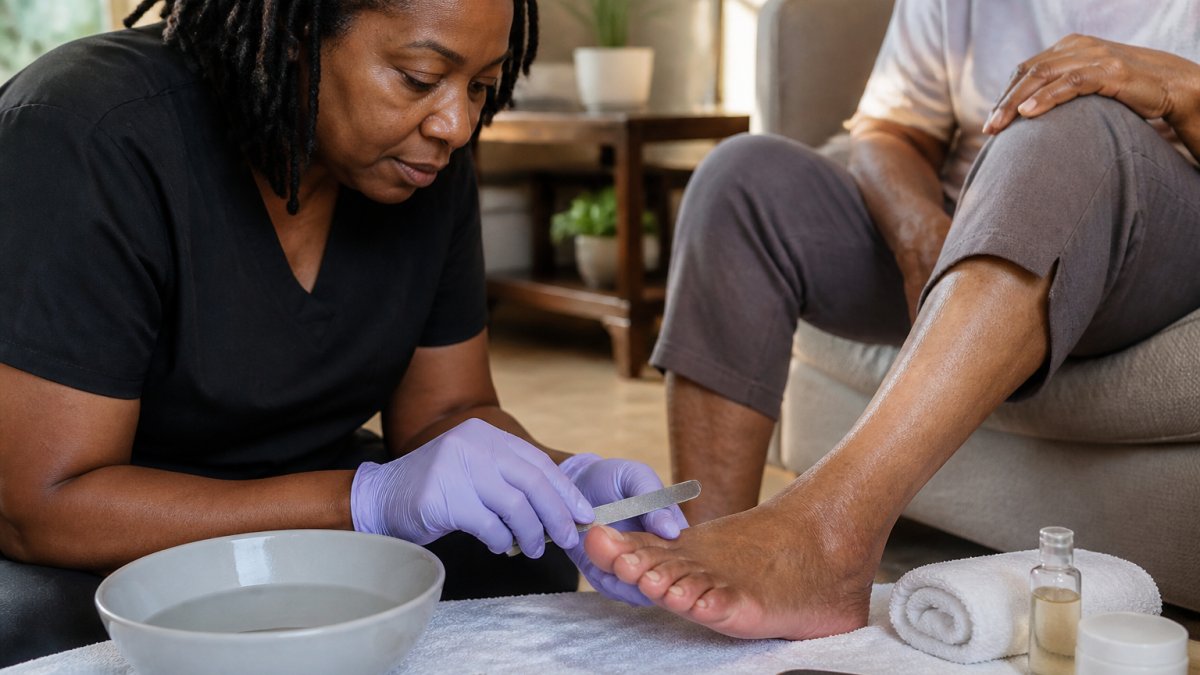
Mobile foot care is a scheduled, in-home clinical service where a licensed nurse assesses, treats, and monitors foot health at the patient's residence. It protects mobility, reduces infection risk, and catches problems early in people who struggle to travel to a clinic, combining routine care with ongoing screening rather than one-off cosmetic treatment.
In-home visits remove the travel problem entirely, so seniors avoid taxis, waiting rooms, and stairs.
A typical visit includes history review, assessment, sensation and circulation screening, treatment, and documentation.
A 2026 study found 90.9% of patients with diabetes had received no foot-care education.
Suggested intervals range from every 6-8 weeks for healthy adults to every 2-4 weeks for diabetes with neuropathy.
Ask providers about their credential, infection control, cancellation policy, and total cost before booking.
Table of Contents
Why Mobile Foot Care Nursing Benefits More Than Just Your Feet
Mobile Foot Care for Seniors: Keeping Mobility Within Reach
What Does a Foot Care Nurse Do During a Home Visit?
Why a Foot Care Nurse for Diabetes Changes the Risk Picture
How Often to See a Foot Care Nurse: Finding Your Schedule
Where Mobile Foot Care Nursing Benefits Fall Short
What to Ask Before You Book a Home Visit
Conclusion
Frequently Asked Questions
Why Mobile Foot Care Nursing Benefits More Than Just Your Feet
Mobile foot care nursing benefits reach well beyond nail trimming. They protect mobility, reduce infection risk, and catch problems early in people who struggle to travel to a clinic. At Foot Care Nursing With Gellis, we see this every week: the feet are often the first place a health problem shows up.
Mobile foot care is a scheduled, in-home clinical service where a licensed nurse assesses, treats, and monitors foot health at the patient's residence. It combines routine care with ongoing screening, which is what separates it from a one-off cosmetic pedicure.
The case for it is straightforward. Researchers evaluating a foot-care education program for nurses and care workers at in-home service providers found that structured training changes how foot problems are identified and managed in the home foot-care education program for nurses and care workers. The clinical knowledge exists. The barrier is access.
That barrier is real. People with limited mobility, chronic pain, or no reliable transportation often skip foot care entirely until something hurts badly enough to force the issue. By then, a minor issue has usually become an expensive one.
Below, we break down who benefits most, what actually happens during a visit, and where the model has genuine limits.
Mobile Foot Care for Seniors: Keeping Mobility Within Reach
For older adults, foot pain is not a minor annoyance. It is a direct threat to independence. A sore toe or a thickened nail changes how someone walks, and altered gait raises fall risk.
Many seniors stop driving or give up walking to the corner store because their feet hurt. In-home care removes the travel problem entirely. No taxi, no waiting room, no stairs to negotiate.
The practical wins are easy to list:
Nail trimming that avoids the cuts and ingrown nails common with reduced vision and reduced reach
Callus and corn reduction that restores comfortable pressure distribution
Early identification of circulation changes, swelling, or skin breakdown
A consistent record of foot health over time
For families coordinating care, the value is continuity. You can explore in-home foot care for seniors and see how a recurring visit fits into an existing care routine.
Pro Tip Ask the nurse to note what footwear the person actually wears indoors. Slippers with worn-down soles are a common and fixable contributor to instability, and it is the kind of detail a clinic appointment never surfaces.
What Does a Foot Care Nurse Do During a Home Visit?
A foot care nurse assesses the whole foot, treats nails and skin, screens for circulation and sensation problems, and documents changes between visits. The visit is clinical, not cosmetic.

A typical visit follows a predictable sequence:
History and medication review. Circulation, diabetes status, and medications that affect healing all change what is safe to do.
Visual and physical assessment. Skin condition, nail thickness, deformities, swelling, and temperature are checked.
Sensation and circulation screening. This is the step that catches neuropathy before a wound develops.
Treatment. Nail care, callus and corn reduction, and management of ingrown toenails within the nurse's scope.
Documentation and advice. Findings are recorded, and footwear, hygiene, and monitoring guidance is given.
The scope matters here. A foot care nurse works within a defined clinical scope, and complex vascular or surgical issues get referred onward. That is a feature, not a gap. Knowing when to escalate is part of the job.
Why a Foot Care Nurse for Diabetes Changes the Risk Picture
Diabetes is where the stakes rise sharply. Reduced sensation means injuries go unnoticed, and reduced circulation means they heal slowly. A small blister can become a serious wound before the person feels anything.
A 2026 study of patients with diabetes reported that 90.9% had received no foot-care education and 54.5% did not perform routine foot care nurse-led diabetic foot self-care study. That gap is exactly what scheduled professional care is designed to close.
What a foot care nurse for diabetes does differently comes down to vigilance:
Screening for loss of protective sensation at every visit
Checking for early signs of ulceration, especially under pressure points
Careful nail and callus work with infection control as the priority
Clear escalation when something needs a physician or wound specialist (Source: data on chronic conditions affecting seniors)
If you live with diabetes, it helps to know what a diabetic foot check involves before your first appointment.
Watch Out Never self-treat a corn, callus, or ingrown nail with over-the-counter acid patches or home cutting when you have diabetes. Reduced sensation means you may not feel the damage you cause, and what starts as a minor wound can escalate quickly.
How Often to See a Foot Care Nurse: Finding Your Schedule
There is no single correct interval. Frequency depends on your risk profile, and the honest answer is that it should be reassessed over time.
A useful starting framework:
Risk Profile | Typical Interval | Main Reason |
Healthy adults with no conditions | Every 6-8 weeks | Routine nail and skin maintenance |
Seniors with mobility limits | Every 4-8 weeks | Fall risk and self-care difficulty |
Diabetes without complications | Every 4-6 weeks | Sensation screening and early detection |
Diabetes with neuropathy or prior ulcer | Every 2-4 weeks | Close monitoring and escalation |
Circulation problems or slow healing | As directed clinically | Highest risk of complications |
Treat that table as a conversation starter, not a prescription. Your nurse will adjust based on what they find.
Where Mobile Foot Care Nursing Benefits Fall Short
In-home care is not the right answer for every situation, and pretending otherwise does a disservice to the people deciding.
The clearest limitation is clinical complexity. Suspected infection, an open wound, significant vascular disease, or a fracture needs a physician, a wound clinic, or emergency care. A foot care nurse will refer you, but they cannot replace that setting.
Cost is the second honest consideration. In-home visits typically carry a premium over a clinic appointment because of travel time, and coverage varies by provider and circumstance. We do not publish fixed rates because pricing depends on your needs and location. Ask for a clear quote up front, and check whether any of it is covered under your extended health benefits or through a government program. Confirm current eligibility rules directly with the official source rather than relying on secondhand information.
The third is scheduling. Home visits run on routes, so flexibility is lower than a walk-in clinic.
None of these are dealbreakers. They are the trade-offs you should weigh against the convenience.
What to Ask Before You Book a Home Visit
Before booking, confirm licensing, scope of practice, infection control, and what happens in an emergency. A short list of questions filters out most of the risk.
Ask these directly:
What is your credential? In Ontario, foot care is delivered by registered nurses, registered practical nurses, chiropodists, and podiatrists, and each has a different scope. Ask which one is coming and what they are licensed to do.
How do you handle infection control? Single-use instruments or documented sterilization, every time.
What is your screening process for staff entering my home?
What is your cancellation and rescheduling policy?
What happens if you find something outside your scope?
What is the total cost, and what does it include?
If you are unsure how the roles differ, it is worth reading a comparison of foot care nurse versus podiatrist in Ontario before you decide who to call.
Key Takeaway The single most useful question is about scope. A provider who can clearly explain what they will not treat, and who they refer to instead, is usually the one who knows what they are doing.
Conclusion
The hardest part of foot care is rarely the treatment itself. It is getting the care to happen at all, consistently, before a small problem becomes a serious one. That is the gap mobile foot care nursing benefits are built to close.
At Foot Care Nursing With Gellis, in-home visits are delivered by a licensed RPN and Foot Care Specialist, with specialized care for seniors and for people living with diabetes. You get clinical assessment in your own home, without the travel.
Book your in-home foot care appointment and get a clear picture of your foot health from someone qualified to assess it.
Frequently Asked Questions
What are the main benefits of mobile foot care nursing?
The biggest benefits are access and consistency. Care comes to you, so mobility limits, transportation costs and waiting rooms drop out of the equation. That matters for people who would otherwise skip appointments and let nail and skin problems build up. In-home visits also let the nurse see your footwear, flooring and daily routine, which shapes better advice. A study found that many patients with diabetes had received no foot-care education and did not perform routine foot care, which shows how easily prevention gets missed when care is hard to reach.
Can a foot care nurse help people with diabetes?
Yes, and this is one of the clearest cases for mobile foot care nursing benefits. A foot care nurse for diabetes checks circulation, sensation, skin integrity and nail condition, then flags changes that need a doctor's attention. Regular visits help catch small problems like a corn, a thickened nail or a minor abrasion before they become wounds. Nurses do not replace your diabetes care team, but they add a consistent set of trained eyes on the feet between medical appointments.
How often should someone receive professional foot care?
There is no single schedule that fits everyone. How often to see a foot care nurse depends on your circulation, sensation, nail growth, skin condition and any chronic illness. Some people do well every eight to twelve weeks; others with diabetes or reduced mobility may need closer intervals. Ask the nurse to recommend a review period after the first visit, and ask your family doctor whether your health history calls for something more frequent.
What is the difference between a foot care nurse and a podiatrist?
A foot care nurse, often a licensed practical or registered practical nurse with foot care training, handles routine and preventive care: nail trimming, callus and corn reduction, skin assessment and education. A podiatrist holds a doctoral-level podiatric qualification and manages structural, surgical and complex medical foot problems. The two roles overlap in basic care. If you have a wound, an infection, a structural deformity or poor circulation, ask for a referral to a podiatrist or your doctor rather than relying on routine care alone.
Book an Appointment
Add footcarenursingwithgellis.com as a preferred source on Google →

Comments